This wiki retires in 2027; content deletion started in 2026. No planned cloud migration.
|
-
Created by
 Sara Stewart, last updated on 17 Aug, 2023
7 minute read
Sara Stewart, last updated on 17 Aug, 2023
7 minute read
Welcome back to INGEST and to the third post of our four-part mini-series on the UNECE Survey. Last time, we deep-dived into some of the results from the survey where we looked at questions relating to the organisational use of geospatial and statistical data and technology. If you haven't read this post yet, you can catch up here: UNECE Survey - Part 2: Data and Technology.
In our third post of this mini-series, we will take a look at some more results from the UNECE Survey which centre around collaboration and partnerships, particularly the level of involvement in wider activities relating to geospatial and statistical data integration at national and international levels. Are you ready to find out more? Let's get started!
So, why explore collaboration and partnerships?
As Isaac Newton famously said:
"If I have seen further it is by standing on the shoulders of giants."
Partnerships, in other words, the strategic alliance of two or more parties who agree to cooperate to advance their shared interests and achieve common goals, have long been viewed as key tools of effective governance. Some partnerships may focus on the delivery of local initiatives at national levels, developing or adapting policy frameworks to better suit the needs of local societies and economies. Other partnerships may seek to coordinate broad policy areas at regional and international scales. But in all cases, successful partnerships are centred around collaboration, drawing on the unique skills that each partner brings to their alliance in order to create new value together (see Collaborative Advantage: The Art of Alliances). At a time when rapid technological change, growing economic and political uncertainty, mounting concerns for the environment and the impacts of climate change, and the effects (whether direct or indirect) of the COVID-19 pandemic transcend national and regional boundaries, effective strategic partnerships can offer valuable contributions to sustainable development and the delivery of innovative, inclusive, targeted, and cost-effective solutions to benefit society.

The strategic partnerships and collaborative activities in place across the statistical and geospatial sectors (as outlined in our earlier post on Data Integration: Key players and recent developments) are strong, long-standing and of benefit to the data integration agenda. Eurostat has observed that statistical and geospatial data integration is growing rapidly in some European countries due to close cooperation between national statistical and geospatial organisations. The European Committee of the Regions further notes that “pan-European interoperability in most fields is still a future goal, however, good progress has been made in particular by several phases of the GEOSTAT projects also regarding the establishment of cooperation between institutions and the integration of spatial and statistical data”. PARIS21, as a global partnership of experts and policymakers in statistics, has also identified that governments in many low-income countries are already implementing multi-stakeholder approaches to progress statistical and geospatial data integration which is very promising. It is, however, important that the international and regional partnerships already in place, some of which are undertaking similar activities relating to data integration, work together to ensure that their workstreams are aligned, and not duplicated, so there is a clear overarching voice that transcends across the different policy frameworks and guidelines that national statistical and geospatial organisations are encouraged to adopt. At national levels, the traditional separation of statistical and geospatial organisations has historically hampered efforts to collaborate with each other, although this is now changing with many good examples of national collaboration in practice (more on that in a later post).
What did the UNECE Survey find out?
In light of the importance of effective collaboration and partnership arrangements to support activities to integrate statistical and geospatial data, the UNECE Survey asked respondents a series of questions to understand the level of involvement in wider activities relating to data integration at both national and international levels. Some key findings are presented below.
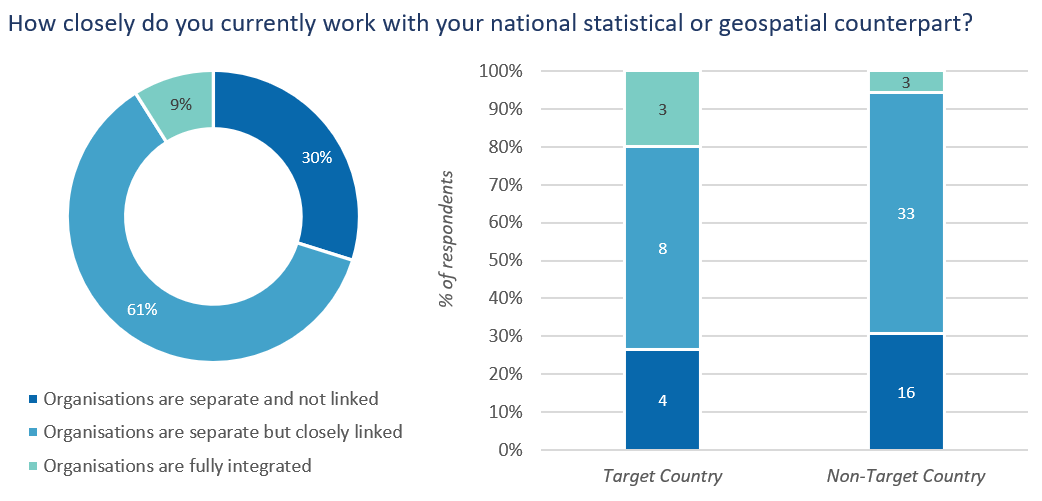
- Survey respondents were asked how closely they worked with their national statistical or geospatial counterpart and most respondents noted that their organisations were separate but closely linked (61%).
- Only 9% of respondent organisations were fully integrated with their statistical or geospatial counterpart.
- These patterns were broadly reflected across both target and non-target country organisations.
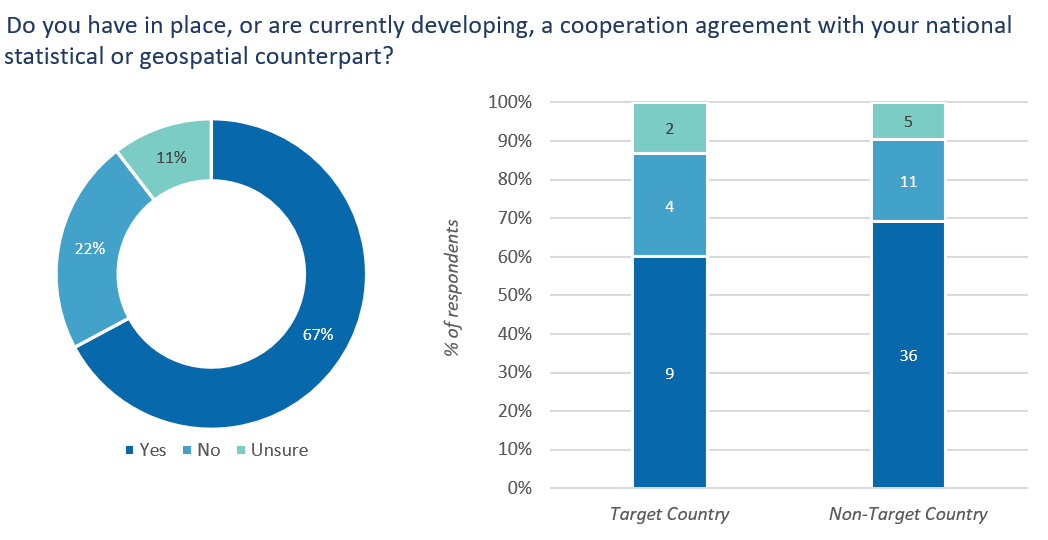
- Most respondents (67%) had a cooperation agreement in place with their national statistical or geospatial counterpart which suggests that there is a relatively good level of cooperation at national levels.
- Target country organisations had a marginally lower level of cooperation (60%) than non-target countries (69%).
- While the form and type of cooperation varied from country to country, ranging from legal obligations to ad hoc meetings, the most common cooperation mechanisms consisted of data sharing agreements, memorandums of understanding, and bespoke agreements (e.g. service level agreements).
- Several organisations are actively working on the development of national cooperation mechanisms to strengthen their governance frameworks, the exchange of information, and the ability to integrate statistical and geospatial information.
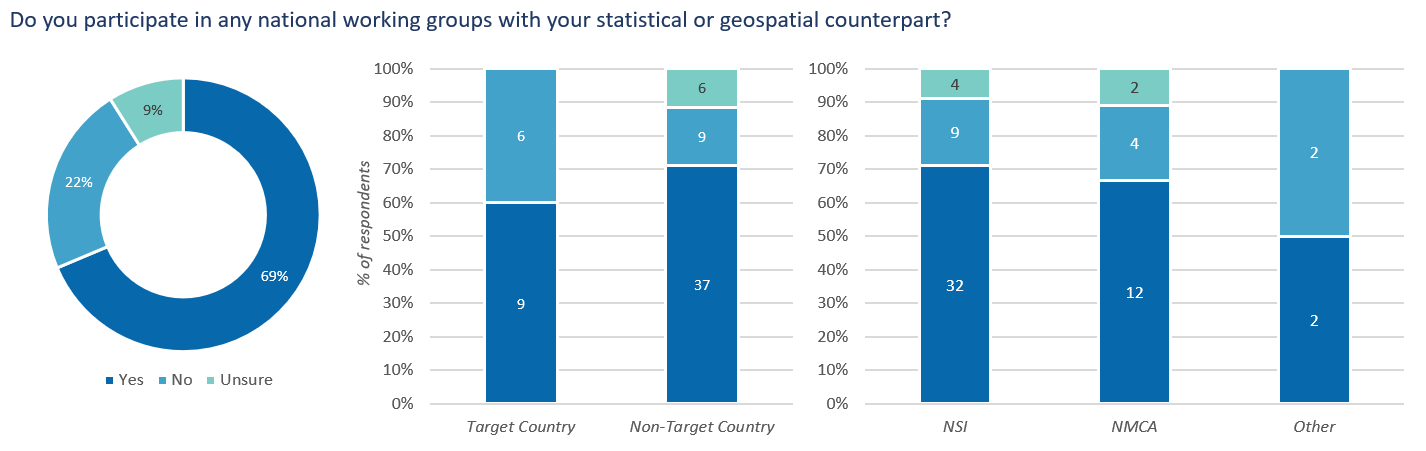
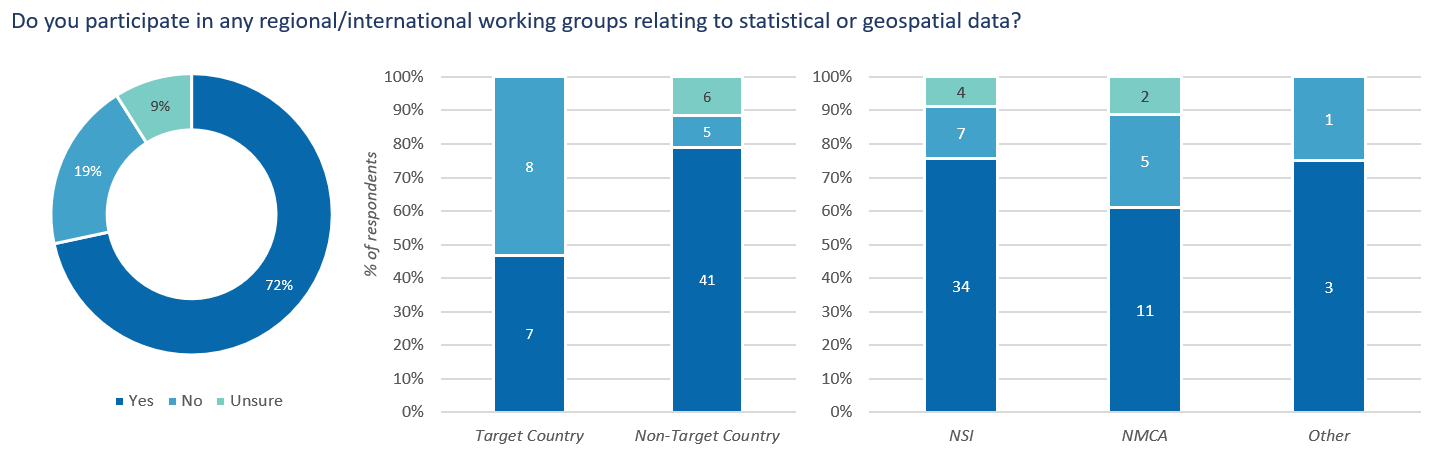
These snapshots from the survey indicate that while the overall level of participation in regional and international activities related to geospatial and statistical data is good overall, as is the breadth and variety of the working groups attended, more needs to be done to explore why levels of engagement from target countries are significantly lower and determine how this can best be remedied. Respondents highlighted the importance of established and agreed collaboration through multilateral partnerships as well as the need for build greater awareness about the strength of partnerships and cooperation amongst different data providers that ensure that reliable, objective, accurate and consistent data can be produced, shared and integrated.
Next time . . .
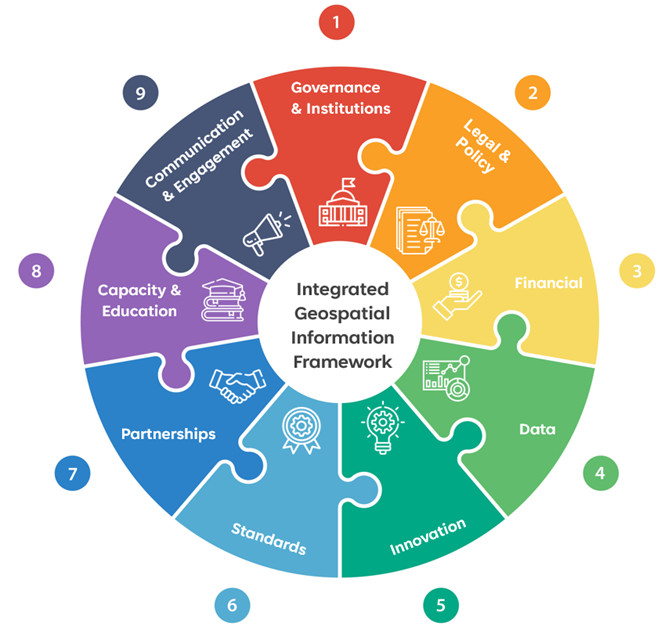
We will end our four-part mini-series on the UNECE Survey by exploring the issues and obstacles that respondents considered were limiting the greater integration of geospatial and statistical data which have been structured according to the strategic pathways of the UN Integrated Geospatial Information Framework (UN-IGIF). More on this soon!

This document was produced with the financial assistance of the European Union. The views expressed herein can in no way be taken to reflect the official opinion of the European Union.