Login required to access some wiki spaces. Please register to create your login credentials
|
search
attachments
weblink
advanced
Overview
Community Forums
Content Tools

Welcome back to the final instalment of our four-part mini-series on the UNECE Survey. Last time, we delved into more results from the UNECE Survey which focused on collaboration and partnerships and the level of involvement in wider activities relating to geospatial and statistical data integration at national and international levels. If you missed this post, you can read it here: UNECE Survey - Part 3: Collaboration and Partnerships.
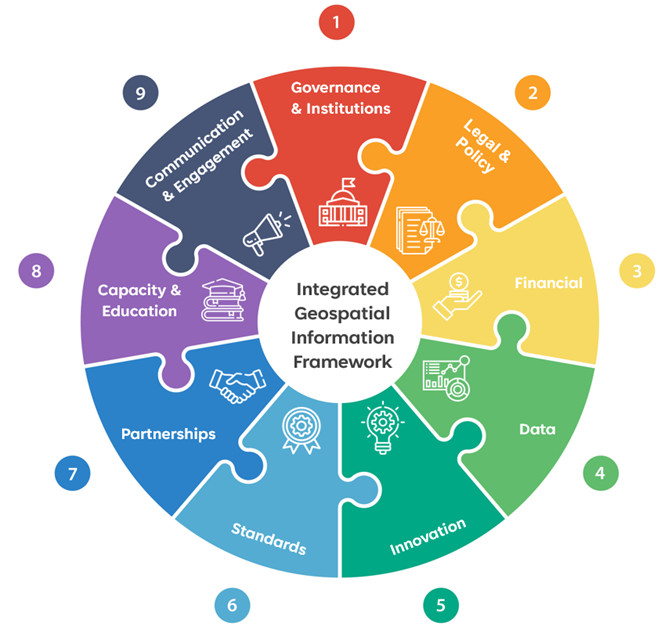
In this post, we will end our four-part mini-series on the UNECE Survey by exploring some of the issues and obstacles that respondents considered were limiting the greater integration of geospatial and statistical data across the UNECE region. The questions relating to this section of the UNECE Survey were structured according to the nine strategic pathways of the UN Integrated Geospatial Information Framework (UN-IGIF).
The UN-IGIF is a reference guide to support governments in the development and strengthening of integrated geospatial information management practices and their inclusion in national plans and strategies. It is also intended to be used as a tool for engagement that will lead to better “coordination, collaboration and coherence across government when working towards strengthening national geospatial information management” (UN-IGIF Part 1 - Overarching Strategic Framework).
It has nine strategic pathways which relate to three broader areas of influence: governance, technology, and people.
- Governance and Institutions
- Legal and Policy
- Financial
- Data (& Technical Infrastructure)
- Innovation
- Standards
- Partnerships
- Capacity and Education
- Communication and Engagement
Given the importance and relevance of this framework to the integration of geospatial and statistical information, the UNECE Survey asked respondents to rate, from their organisation's perspective, the degree of impact that each strategic pathway had on their ability to progress data integration activities and were asked to provide further information on those ratings. We will be looking at the UN-IGIF in much more detail in a later post.

What did the UNECE Survey reveal?

The chart to the left shows the overall respondent rating of the degree of impact that each UN-IGIF strategic pathway had on their organisation's ability to progress activities to integrate statistical and geospatial data. For the purpose of this blog post, we will focus on the top three strategic pathways which were rated as having the highest impact on data integration. These are:
1. Financial
2. Communication and Engagement
3. Data & Technical Infrastructure
Financial issues were rated as having the highest impact on data integration in both target and non-target countries, as well as in National Statistical Institutes (NSIs), however, respondents from National Mapping and Cadastral Agencies (NMCAs) considered that communication and engagement issues had the bigger impact which should be noted.
We will now dig a bit deeper and discuss some of the reasons behind these ratings.
1. Financial
Financial issues were identified as the biggest obstacle to the greater integration of statistical and geospatial data across the UNECE region, with 54% of survey respondents ranking it as high impact. The level of impact was drastically higher for organisations in target countries (73%) than non-target countries (48%), but relatively similar for NSIs (56%) and NMCAs (50%). Respondents noted the lack of financial support, both through the appropriate allocation of government funding and the lack of investment by international and EU donors, as the biggest financial obstacle to greater data integration. They emphasised that the issue would only be compounded by the impact of future planned budget cuts at some government levels, threatening the sustainability of systems and the technical infrastructure required for effective and efficient data lifecycles. One respondent highlighted the lack of sustainable financial resources necessary to create and maintain their national spatial data infrastructure which was particularly impacting the improvement and implementation of national and international standards for their primary geospatial datasets. Another noted that part of their organisational budget came from custom work packages from government and private organisations, but the overly bureaucratic procedures required to get such work funded and initiated required lot of staff time and resource that could be better spent elsewhere. Several respondents also highlighted the importance of, and need for, adequate investment in staff training to ensure highly qualified staff could contribute effectively to data integration activities. Also of importance was the ability to fund and maintain innovative hardware and software packages and the efficiency gains they could bring. Overall, as one participant aptly summarised, there is a need for decision-makers to understand the concrete benefits of data integration so they can invest in such activities and raise the capacity of key institutions and the qualifications of staff. New financial models are needed based on investment needs and funding sources for the delivery of integrated statistics and geospatial information management.

2. Communication and Engagement
Issues relating to communication and engagement were ranked as having the second highest impact on the greater integration of geospatial and statistical information, with 43% of respondents rating it as high impact. A marginally higher number of respondents from target country organisations rated it as high impact (47%) than from non-target countries (42%). A much more marked difference was, however, evident by organisation type as 72% of respondents from NMCAs rated it as high impact in comparison to 31% of respondents from NSIs, indicating that more efforts were required to improve communication and engagement strategies towards geospatial organisations in particular. Respondents highlighted the need for greater engagement with decision-makers at strategic levels through the development of stronger communication strategies which emphasise key messages around the benefits of integrating statistical and geospatial information and its importance for evidence-based decision-making to support the 2030 Agenda and the achievement of its SDGs. Some respondents also noted the need for more open communication between NSIs and NMCAs, a shared commitment to data integration activities, and established and agreed roles to progress data integration at national levels, particularly centred around the promotion of National Spatial Data Infrastructures and their role in supporting all stages of the statistical process. It is clear that new communication and engagement strategies are needed to promote the benefits of data integration to a much broader target audience than present, actively engaging with decision-makers from target country organisations and NMCAs in particular. In growing awareness of, and acquiring buy-in to, data integration activities, real progress can be made, and the benefits truly realised.

3. Data & Technical Infrastructure
Data and technical infrastructure issues were ranked as having the third highest impact on the integration of geospatial and statistical data, with 42% of respondents rating it as high impact. The level of impact was much higher for target countries (53%) than non-target countries (38%) and, similarly, for NSIs (49%) than NMCAs (28%). This clearly indicates that more efforts are required to support data integration activities within NSIs, particularly in the target country areas. Respondents cited that the biggest obstacles related to data interoperability, with different data collection and storage methods, unstandardised data formats, and a lack of unique identifiers resulting in an inability to integrate data sources from different institutions. The quality, currency and completeness of available data was also noted as impacting data integration activities, as was the ability to make data available to share and reuse through robust and secure technical infrastructures and standardised procedures. Limitations in hardware and software components, particularly relating to performance issues, the need for major system upgrades and additional servers, as well as support for dedicated software packages, were further impacting the ability to progress data integration activities. In many ways, the issues and obstacles cited above are very much a consequence of the financial issues discussed above as well as the lack of appropriate standards for data harmonisation. A multi-faceted approach is therefore necessary to ensure that data, and the technical infrastructure it sits within, is suitable for data integration activities that are sustainable into the future.

So, where do we go from here?
This blog post has focused on the top three strategic pathways which were rated as having the highest impact on data integration within the UNECE Survey, although there are also other wider issues at play. While much work has been undertaken to support the greater integration of geospatial and statistical information, more must be done to embed data integration activities within business-as-usual practices in a comparable and consistent fashion across the UNECE region. There are a range of multi-dimensional issues and obstacles still to be overcome, given the wide variance in national governance frameworks, laws and policies, the ability to access adequate and sustainable financial resources, the level of cooperation with other national and international bodies, the adherence to wider policy frameworks and common standards, the ability, skills and capacity to innovate, and effectively communicate the need for data integration activities and their associated benefits to both decision-makers and the wider user community.
In light of the issues and obstacles explored in this blog post, some recommendations can be made:
1. Identify and promote sustainable funding resources and models to support data integration activities at national levels.
2. Enhance communication and engagement strategies to grow awareness of the benefits of data integration and better support the sharing of best practice and new technologies.
3. Promote greater data standardisation and interoperability through the use of harmonised standards, operating models, production processes and services.
These recommendations could support and complement other key recommendations made by UNECE, Eurostat and others in the field of data integration and, in their adoption, may provide a driving force for change so that the value of data integration is fully realised and data of sufficient quality, accessibility, currency, reliability and granularity is produced consistently to protect people, the planet, prosperity, peace and partnerships so that “no one will be left behind” (United Nations).

This document was produced with the financial assistance of the European Union. The views expressed herein can in no way be taken to reflect the official opinion of the European Union.

Images in this blog were sourced from Flaticon.com.
Welcome back to INGEST and to the third post of our four-part mini-series on the UNECE Survey. Last time, we deep-dived into some of the results from the survey where we looked at questions relating to the organisational use of geospatial and statistical data and technology. If you haven't read this post yet, you can catch up here: UNECE Survey - Part 2: Data and Technology.
In our third post of this mini-series, we will take a look at some more results from the UNECE Survey which centre around collaboration and partnerships, particularly the level of involvement in wider activities relating to geospatial and statistical data integration at national and international levels. Are you ready to find out more? Let's get started!
So, why explore collaboration and partnerships?
As Isaac Newton famously said:
"If I have seen further it is by standing on the shoulders of giants."
Partnerships, in other words, the strategic alliance of two or more parties who agree to cooperate to advance their shared interests and achieve common goals, have long been viewed as key tools of effective governance. Some partnerships may focus on the delivery of local initiatives at national levels, developing or adapting policy frameworks to better suit the needs of local societies and economies. Other partnerships may seek to coordinate broad policy areas at regional and international scales. But in all cases, successful partnerships are centred around collaboration, drawing on the unique skills that each partner brings to their alliance in order to create new value together (see Collaborative Advantage: The Art of Alliances). At a time when rapid technological change, growing economic and political uncertainty, mounting concerns for the environment and the impacts of climate change, and the effects (whether direct or indirect) of the COVID-19 pandemic transcend national and regional boundaries, effective strategic partnerships can offer valuable contributions to sustainable development and the delivery of innovative, inclusive, targeted, and cost-effective solutions to benefit society.

The strategic partnerships and collaborative activities in place across the statistical and geospatial sectors (as outlined in our earlier post on Data Integration: Key players and recent developments) are strong, long-standing and of benefit to the data integration agenda. Eurostat has observed that statistical and geospatial data integration is growing rapidly in some European countries due to close cooperation between national statistical and geospatial organisations. The European Committee of the Regions further notes that “pan-European interoperability in most fields is still a future goal, however, good progress has been made in particular by several phases of the GEOSTAT projects also regarding the establishment of cooperation between institutions and the integration of spatial and statistical data”. PARIS21, as a global partnership of experts and policymakers in statistics, has also identified that governments in many low-income countries are already implementing multi-stakeholder approaches to progress statistical and geospatial data integration which is very promising. It is, however, important that the international and regional partnerships already in place, some of which are undertaking similar activities relating to data integration, work together to ensure that their workstreams are aligned, and not duplicated, so there is a clear overarching voice that transcends across the different policy frameworks and guidelines that national statistical and geospatial organisations are encouraged to adopt. At national levels, the traditional separation of statistical and geospatial organisations has historically hampered efforts to collaborate with each other, although this is now changing with many good examples of national collaboration in practice (more on that in a later post).
What did the UNECE Survey find out?
In light of the importance of effective collaboration and partnership arrangements to support activities to integrate statistical and geospatial data, the UNECE Survey asked respondents a series of questions to understand the level of involvement in wider activities relating to data integration at both national and international levels. Some key findings are presented below.
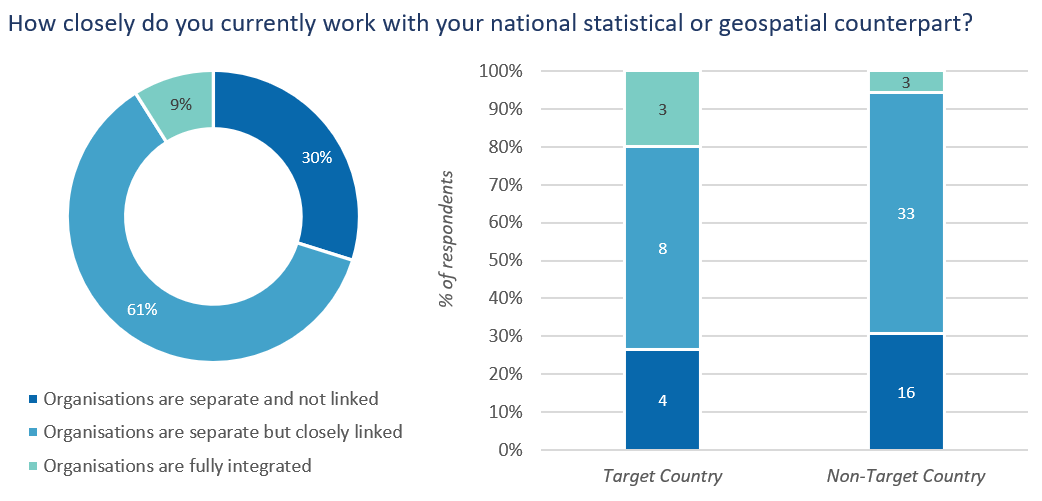
- Survey respondents were asked how closely they worked with their national statistical or geospatial counterpart and most respondents noted that their organisations were separate but closely linked (61%).
- Only 9% of respondent organisations were fully integrated with their statistical or geospatial counterpart.
- These patterns were broadly reflected across both target and non-target country organisations.
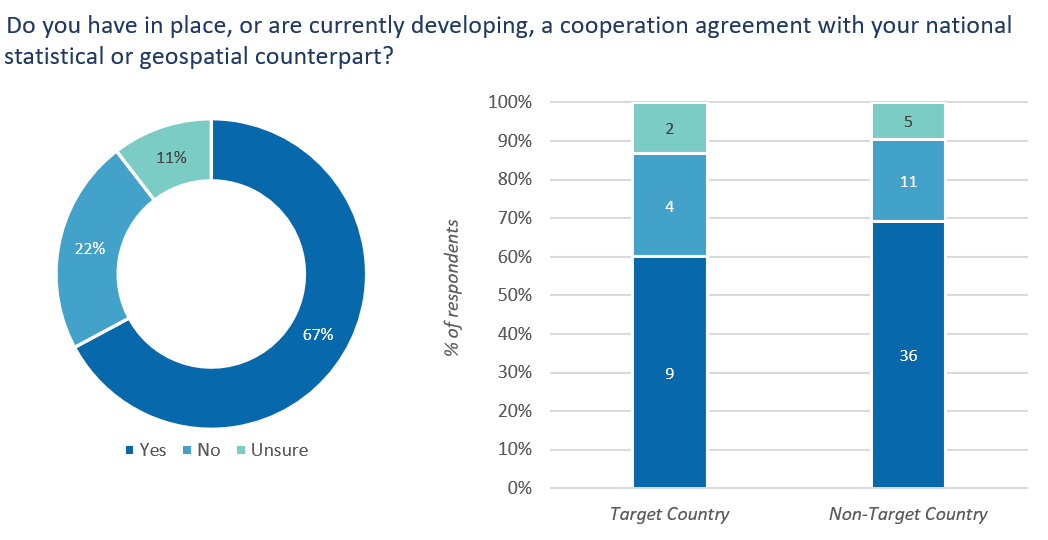
- Most respondents (67%) had a cooperation agreement in place with their national statistical or geospatial counterpart which suggests that there is a relatively good level of cooperation at national levels.
- Target country organisations had a marginally lower level of cooperation (60%) than non-target countries (69%).
- While the form and type of cooperation varied from country to country, ranging from legal obligations to ad hoc meetings, the most common cooperation mechanisms consisted of data sharing agreements, memorandums of understanding, and bespoke agreements (e.g. service level agreements).
- Several organisations are actively working on the development of national cooperation mechanisms to strengthen their governance frameworks, the exchange of information, and the ability to integrate statistical and geospatial information.
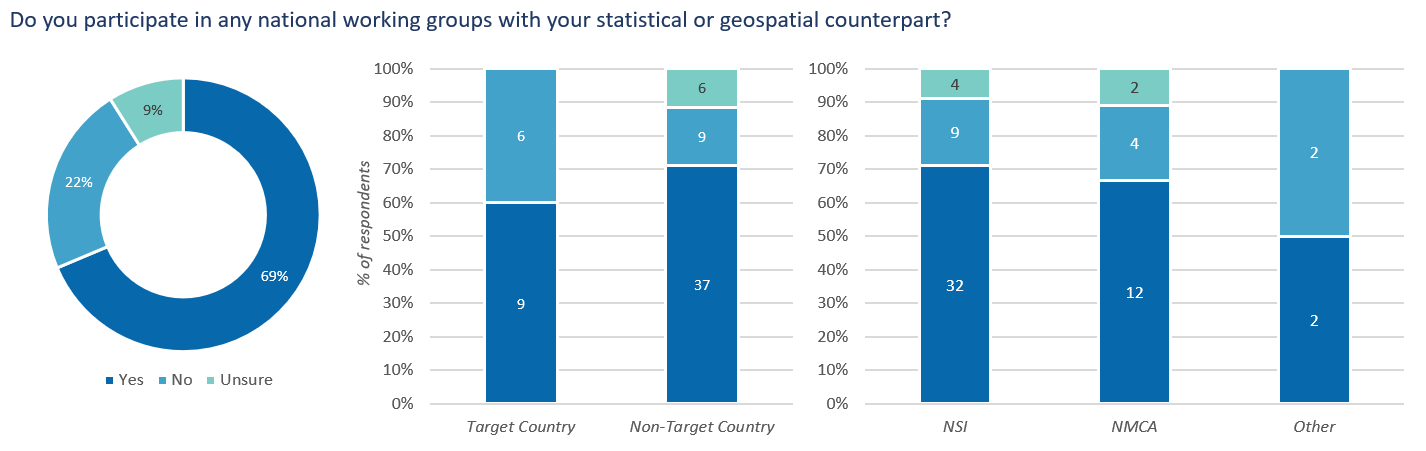
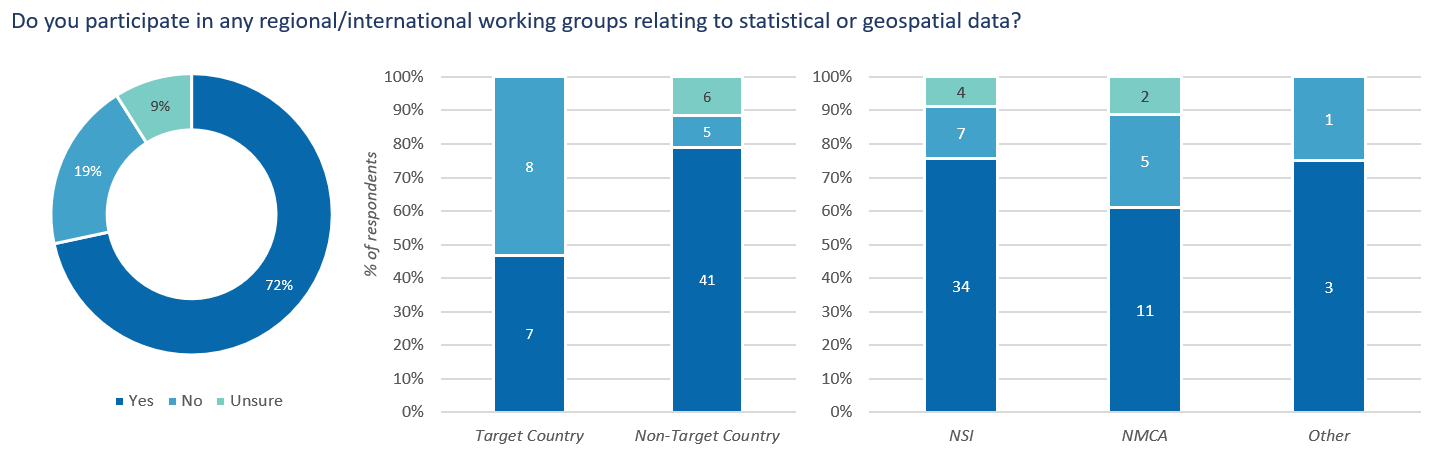
These snapshots from the survey indicate that while the overall level of participation in regional and international activities related to geospatial and statistical data is good overall, as is the breadth and variety of the working groups attended, more needs to be done to explore why levels of engagement from target countries are significantly lower and determine how this can best be remedied. Respondents highlighted the importance of established and agreed collaboration through multilateral partnerships as well as the need for build greater awareness about the strength of partnerships and cooperation amongst different data providers that ensure that reliable, objective, accurate and consistent data can be produced, shared and integrated.
Next time . . .
We will end our four-part mini-series on the UNECE Survey by exploring the issues and obstacles that respondents considered were limiting the greater integration of geospatial and statistical data which have been structured according to the strategic pathways of the UN Integrated Geospatial Information Framework (UN-IGIF). More on this soon!

This document was produced with the financial assistance of the European Union. The views expressed herein can in no way be taken to reflect the official opinion of the European Union.

Hello again and welcome back to INGEST. Last time, we shared the first post of a four-part mini-series on the UNECE Survey where we introduced you to an EU-funded project being led by UNECE to develop capacity in geospatial and statistical data integration, and provided some background and context to the survey. If you missed this post, you can find it here: UNECE Survey - Part 1: Background and Context
In the second part of this mini-series, we will dive in to the results from the UNECE Survey where we will focus on questions relating to the organisational use of geospatial and statistical data and technology. Let's get started!
Firstly, why look at the use of data and technology?
Well, on a global scale, society is becoming ever more data-driven with more than 2.5 quintillion bites of data being generated every day (which is quite something)! The availability of quality data that is accurate, comprehensive, at an appropriate level of detail and temporality, and from verifiable and authoritative sources, is critical for evidence-based decision-making and policy development across all levels. Data plays a central role in the 2030 Agenda and the ability to fully measure and monitor progress on the SDGs. Not only is the quality of data important, but also the strength of the technical infrastructure which underlies its creation, management, use, and dissemination within and across organisations. A strong data infrastructure will ensure better efficiency and productivity of its users, ease of collaboration between different groups, and securely managed access to organisational data for both internal and external users. By utilising appropriate digital technologies and methodological frameworks to collect, analyse and interpret data, real actionable insights can be obtained. Yet, these benefits have not yet been fully realised in a consistent way as the World Bank notes: “Even as new technology makes more data and wider uses of data possible, there are still many blank spaces on the global data map”. While both the quality and availability of data has been growing over recent years, in general, it is considered that “statistical capacity still needs strengthening and data literacy must be enhanced at all levels of decision-making” which will “require coordinated efforts on the part of data producers and users from multiple data systems" (UN Statistics Division).

The quality and accessibility of statistical and geospatial data, and the strength of the technical infrastructure that supports it throughout its lifecycle, is central to the data integration agenda. At a global level, it has been recognised that advances in the integration of statistical and geospatial data have "benefitted from the availability of powerful geospatial tools that enhance the value and usability of official statistics by leveraging the application of the spatial context" (PARIS21). The GEOSTAT 4 / GISCO survey also revealed that around 50% of the countries surveyed reported that they had a strong and sustainable data infrastructure that could support the integration of statistical and geospatial information. The INSPIRE Directive also brought the importance of metadata, and its uniform structure, to the fore in the management of spatial datasets, providing definitions and lists of categories to describe the content, data type, and usage. As UNECE have highlighted, there is also the “prior existence of flexible frameworks for the modernisation of official statistics that can be adapted to include geospatial information with little impact on the existing organisational structure”. For example, UNECE’s Generic Statistical Business Process Model (GSBPM) has recently been enhanced to include a geospatial perspective, appropriately termed GeoGSBPM. We will be discussing the GeoGSBPM in more detail in a later post. From these few examples, it is clear that good progress has been made at global and regional scales to highlight and support the development and maintenance of high-quality data and robust technical infrastructures, but issues still remain which hinder the greater integration of statistical and geospatial information at national levels.
So, what did the UNECE Survey discover?
Recognising the central role that data and technology play in the integration of geospatial and statistical information, the UNECE Survey asked respondents a number of questions relating to their organisational use of data and technology. Some highlights are presented below:
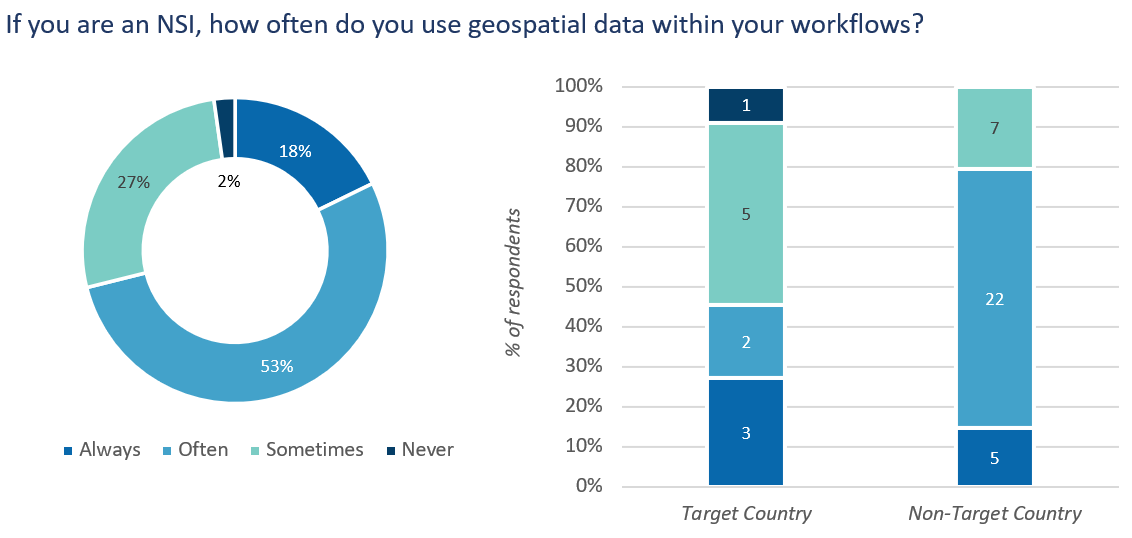
- Most respondents from National Statistical Institutes (NSIs) often (53%) or always (18%) used geospatial data within their workflows.
- Only one NSI respondent never used geospatial data in their workflows.
- A lower proportion of NSI respondents from the project's target countries (located in Eastern Europe, the Caucasus and Central Asia) always or often used geospatial data within their workflows (45%) in comparison to non-target countries (79%).
- Respondents noted a broad range of uses for geospatial data within statistical processes, with the most common relating to census operations, geocoding, spatial analysis, and dissemination activities. Several respondents also discussed their production of grid statistics, particularly in relation to population and age information.
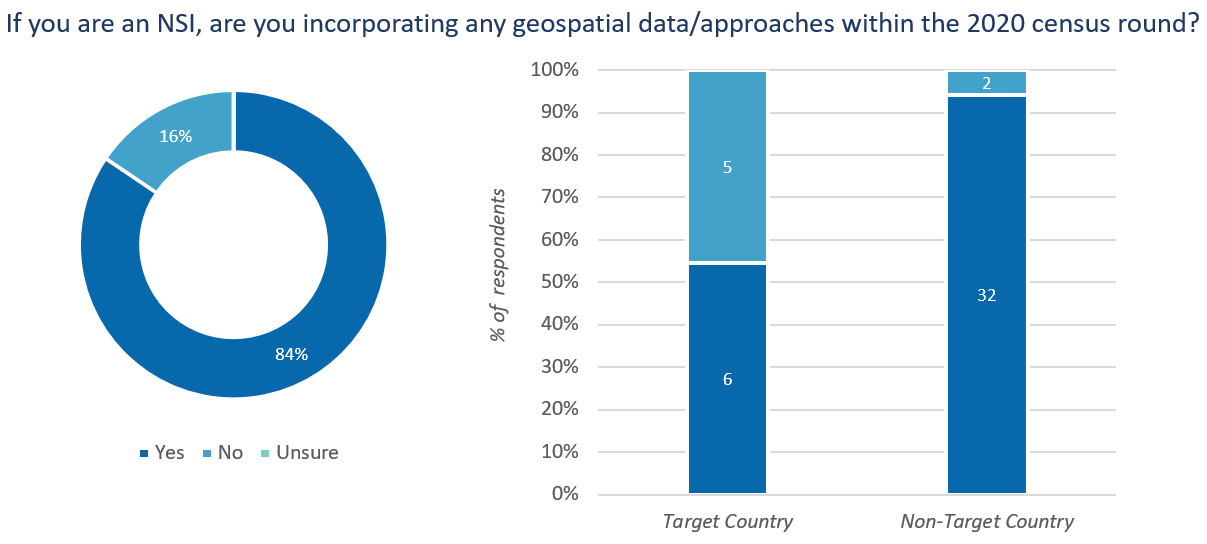
- An overwhelming majority (84%) of NSI respondents have, or are planning to incorporate, geospatial data within the 2020 census round.
- The proportion of NSIs using geospatial data within their census activities was much lower in target countries (55%) than non-target countries (94%).
- The most common uses of geospatial data within census operations related to the geocoding of address data for building and dwelling registers, the production of enumeration areas, the monitoring of data collection and census progress, and the creation and dissemination of grid statistics (primarily at the 1 kilometre-squared grid level but as high as 100 metres-squared).
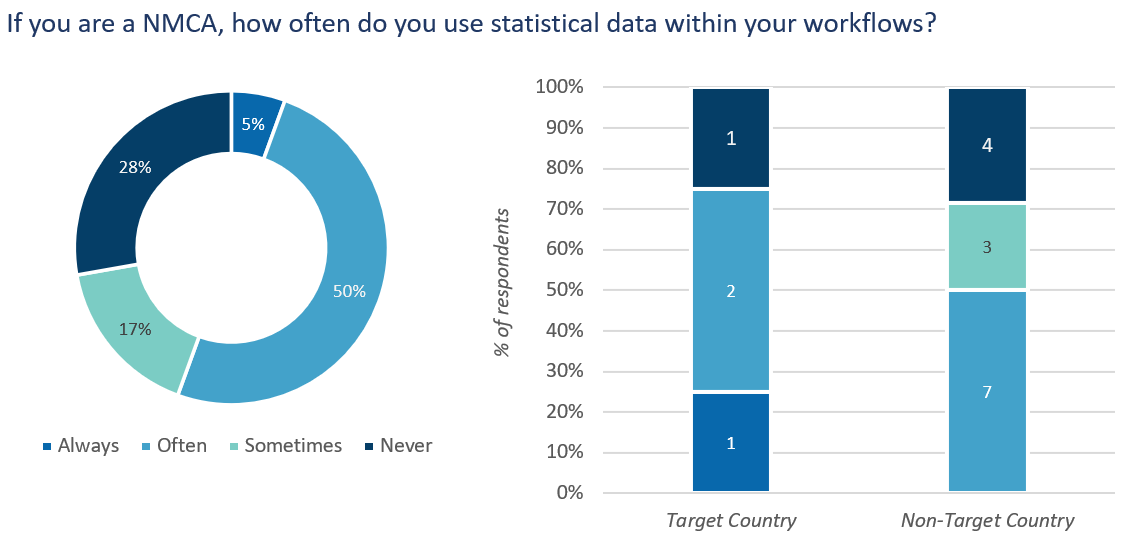
- A slight majority of respondents from National Mapping and Cadastral Agencies (NMCAs) often (50%) or always (5%) used statistical data in their workflows which is much lower than the converse reported by NSIs (as above).
- 28% of NMCA respondents never used statistical data in their workflows which is much higher than the converse reported by NSIs.
- A higher proportion of NMCA respondents from target countries always or often used statistical data (75%) than from non-target countries (50%).
- Common uses of statistical data within geospatial activities included within data production and management processes, thematic map production (particularly using population and census data), and spatial analysis using demographics and deprivation indices to inform policy development and emergency preparedness and response.
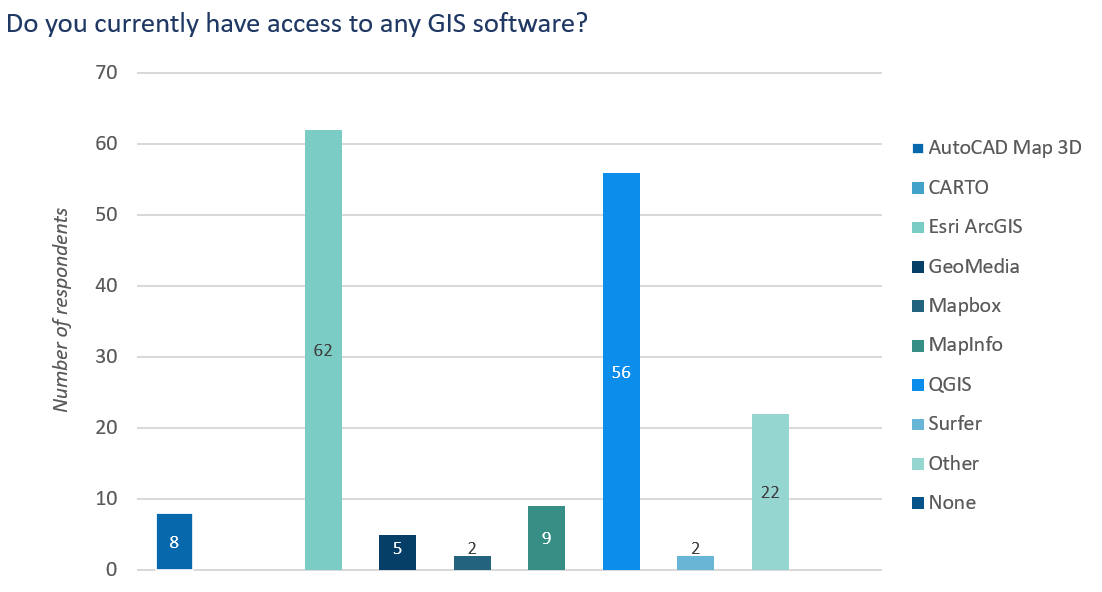
- All respondents, whether NSI or NMCA, had access to some form of GIS software, with the most popular being Esri ArcGIS software (37%) followed closely by open-source QGIS software (34%), and then other more bespoke or internally-developed software applications and packages (22%).

- The vast majority of respondents (with the exception of three organisations) had access to one or more statistical software packages, the most common being Microsoft Excel (28%), R (20%) and Python Statistics Libraries (15%).
These highlights from the survey suggest that organisations who responded to the survey are integrating geospatial/statistical data within their workflows and have a good level of access to relevant software to support such tasks. It is clear, however, that there are some disparities in the extent of data integration activities between NSIs and NMCAs and, similarly, between target and non-target countries. In a later post, we will share some of the issues and obstacles relating to data and technology which were highlighted by respondents to the survey.
Next time . . .
We will continue with the third part of our mini-series and share more results from the UNECE Survey which will focus on collaboration and partnerships, exploring the level of involvement in wider activities relating to geospatial and statistical data integration at national and international levels. We hope to see you then!


This document was produced with the financial assistance of the European Union. The views expressed herein can in no way be taken to reflect the official opinion of the European Union.

Welcome to another instalment of INGEST! We hope that you have enjoyed reading our earlier posts where we introduced you to the concept of integrating geospatial and statistical data, highlighted why it is important, presented some of the key players in the field, and brought you up to speed on recent developments and activities.
We would now like to introduce you to an EU-funded project being led by UNECE to develop capacity in geospatial and statistical data integration across the UNECE region and present some results from the recent UNECE Survey on the Integration of Statistical and Geospatial Information which was undertaken as part of this project.
As there is a lot of talk about, we have developed a four-part mini-series where we will provide an overview of the project and present some results from the survey as follows:
- Part 1: Background and context
- Part 2: Data and technology
- Part 3: Collaboration and partnerships
- Part 4: Issues and obstacles
In the first post of this mini-series, we will introduce you to the project and provide some background and context to the UNECE Survey. Are you ready to find out more? Let's go!!
So, tell me more about your EU-funded project to develop capacity in geospatial and statistical data integration . . .
As we outlined in our first post (Welcome to INGEST), the role of integrated data as a driver for evidence-based decision-making has never been more important and has been brought to the fore by the 2030 Agenda and its call for data that is accurate, current and of high-resolution to measure and monitor the achievement of its Sustainable Development Goals. In our previous post (Key players and recent developments) we also discussed how global efforts to drive the greater integration of statistical and geospatial data have been going on for a decade and many great outcomes have been achieved, however, the benefits have not yet been fully realised consistently across the UNECE region due a to range of complex but interconnected reasons (which we will discuss in a later post).
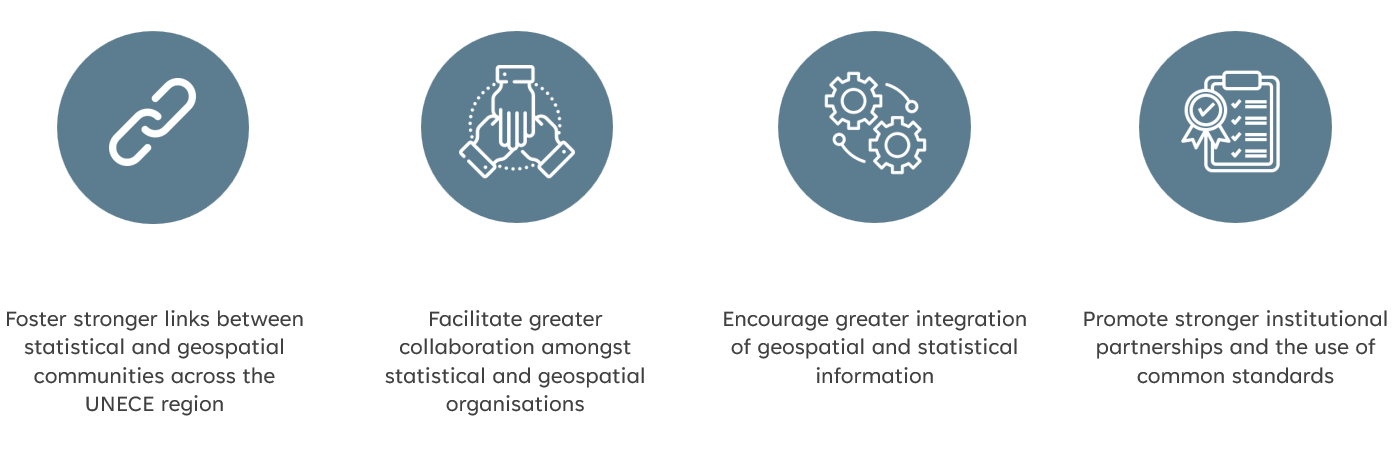
Recognising the potential for growth, the European Commission has funded a 21-month project, currently being led by UNECE, to develop greater capacity in statistical and geospatial data integration across the UNECE region to foster stronger links between the two communities, support greater collaboration and encourage greater data integration through the promotion of stronger institutional partnerships and the adoption of common standards. The project is supporting existing activities to strengthen the integration of statistical and geospatial information by Eurostat, UN-GGIM: Europe and others, and has a particular focus on sixteen selected target countries in Eastern Europe, the Caucasus and Central Asia.
A number of key activities are being undertaken as part of the project including (amongst other things):
- Issuing an online survey to gain stakeholder insights on data integration (more on that below).
- Organising a Joint UNECE / Eurostat / UN-GGIM: Europe Workshop on Integrating Statistical and Geospatial Data which will take place in Belgrade, Serbia on the 4-5 October 2023.
- Establishing a UNECE-led task force on standards issues relating to data integration.
- Creating supportive material on data integration including a UNECE wiki space, this blog series, and other documentation.
By carrying out these activities, the project hopes to:
- Increase awareness of the need for more integration of geospatial and statistical data, especially within the project's target countries.
- Develop a better understanding of the limitations of current geospatial and statistical data standards in the context of data integration.
- Improve collaboration between the geospatial and statistical communities based on greater mutual awareness and understanding.
What is the UNECE Survey on Integration of Statistical and Geospatial Information all about?
Well, the UNECE Survey on the Integration of Statistical and Geospatial Information was developed as part of the wider project to:
- Obtain valuable insight on data integration from statistical and geospatial communities across the UNECE region.
- Ensure that the views of key stakeholders were included within the project.
- Acquire user-centric feedback to accurately inform and target the direction of future project activities.
The UNECE Survey was issued to all National Statistical Institutes (NSIs) and National Mapping and Cadastral Agencies (NMCAs) located across the UNECE region in the spring of 2023. The survey was designed around four key areas:
- The use of data and technology to support data integration.
- The level of involvement in wider activities relating to geospatial and statistical data integration at national and international levels.
- Develop an understanding of the issues and obstacles limiting the greater integration of geospatial and statistical data, structured using the strategic pathways of the UN Integrated Geospatial Information Framework (UN-IGIF).
- Provide an opportunity for NSIs and NMCAs to register their interest in future project activities.
Could you tell me more about who responded to the UNECE Survey?
Absolutely, we are pleased to share that the UNECE Survey received a great response as the below map shows:

Key facts and figures:
- 67 organisations from 49 countries responded to the survey.
- Survey respondents came from across the UNECE region and beyond, including Brazil, Chile, China, Colombia, India, Japan, and Mexico.
- 15 respondents came from a project target country located in Eastern Europe, the Caucasus or Central Asia.
- 45 (67%) respondents were from NSIs, 18 (27%) were from NMCAs, and 4 (6%) were from other institutions (where the national statistical and geospatial functions were combined or had an academic or research function).
- In 17 countries, responses were received from both the NSI and NMCA, ensuring that valuable dual perspectives from statistical and geospatial communities were obtained at national levels. Four of these countries were a target country of the project.
Next time . . .
We will present more results from the UNECE Survey in the second part of our mini-series which will focus on the organisational use of geospatial and statistical data and technology. See you then!


This document was produced with the financial assistance of the European Union. The views expressed herein can in no way be taken to reflect the official opinion of the European Union.
