Welcome to another instalment of INGEST! In our recent posts, we focused on our EU-funded project which aims to develop greater capacity in integrating geospatial and statistical data across the UNECE region, presenting some results from the UNECE Survey on the Integration of Statistical and Geospatial Information and sharing the low-down on the first Joint UNECE / Eurostat / UN-GGIM: Europe Workshop on Integrating Statistical and Geospatial Information which took place in Belgrade, Serbia in October. If you missed these posts, you can catch up through the links shown here.
We would now like to move our focus to some of the key policy frameworks relating to data integration, and where better to start than the Global Statistical Geospatial Framework, or GSGF for short! In this post, we will explore this global framework, look at its adaption to the European context by the GEOSTAT 4 project (the GSGF Europe), before highlighting an exciting new project which is interpreting the GSGF within a national operating environment (the GSGF in Finland—Integration of geospatial and statistical information in Finland project). We hope that you will become more familiar with the framework, recognise its value for integrating geospatial and statistical information, understand how flexible and adaptable it is to differing regional and national contexts, and be inspired to adopt the GSGF within your own operating environment. Are you ready to find out more? Let's get started!
The Global Statistical Geospatial Framework
At a global level, the 2030 Agenda for Sustainable Development has been a driving force for the greater integration of statistical and geospatial data as it requires robust, harmonised data at granular levels of geography for the production and monitoring of SDG indicators. In support of the 2030 Agenda, the Population and Housing Censuses, and other important development initiatives ranging from local to global levels, UN-GGIM published the Global Statistical Geospatial Framework (GSGF) in 2019 as a key policy framework to act as a “bridge between statistical and geospatial professional domains, between NSOs [National Statistical Organisations] and NGIAs [National Geospatial Information Agencies], and between statistical and geospatial standards, methods, workflows and tools” (GSGF, p. 6). By applying the framework's five Principles and four Key Elements, the production of high-quality "harmonised, standardised and geospatially-enabled statistical data" (ibid., p. vii) can be realised. Such data plays a valuable role in informing, supporting and driving evidence-based decision-making and policy development across all geographic scales.
The GSGF is clearly summarised in this useful (and, by now, very famous) diagram shown to the right. It comprises of:
- Geospatial and statistical data Inputs
- Five Principles which outline broad processes to enable statistical and geospatial data integration and work through a hierarchical "bottom-up" approach:
- Use of fundamental geospatial infrastructure and geocoding
- Geocoded unit record data in a data management environment
- Common geographies for the dissemination of statistics
- Statistical and geospatial interoperability
- Accessible and useable geospatially enabled statistics
- Four Key Elements which facilitate the application of the five Principles:
- Standards and Good Practice
- National Laws and Policies
- Technical Infrastructure
- Institutional Collaboration
- Resulting Outputs which stem from the GSGF processes and provide “a higher degree of structural harmonisation and standardisation, as well as geospatial flexibility, . . . [and] have an inherently greater capacity for integration based on location and a substantially greater capacity to be further used in more complex statistical data integration” (ibid. p. 8).
 Overview of the inputs, principles, key elements and outputs that form the Global Statistical Geospatial Framework (GSGF, p. 5)
The GSGF is presented as two separate, but complementary, documents:
The Global Statistical Geospatial Framework itself as the main policy document which presents the context and key concepts of the framework. It is already available in six different languages (English, Arabic, French, Mandarin, Portuguese and Spanish) enabling its broad use. The information is presented in three very easy-to-digest parts:
- Part 1 presents the GSGF as a high-level overview of the framework, outlining its Inputs, Principles, Key Elements and Outputs. It is designed to draw the reader in by presenting key information on the framework, highlighting the importance of integrated data and the means to achieve integration.
- Part 2 goes into more detail on each of the five Principles, addressing the need for each Principle, what is covers, the main objective of its use, the requirements and benefits, the relationship to other principles, the data inputs required and the key stakeholders involved.
- Part 3 provides additional supporting information in the form of three annexes, including definitions of key terms, further information on the need to use internationally-adopted standards and the importance of assessing data quality across all stages of the framework, and further reading and resources on other national and international frameworks, standards, and privacy and data disclosure prevention.
The Global Statistical Geospatial Framework: Implementation Guide as an important supporting document which provides detailed guidance on how to implement the GSGF. It acts as a living document which will be periodically updated to include best practices, developments and innovations in the field. It consists of three main sections:
- Implementation guidance on four key areas that are seen as critical to successfully implementing the GSGF: geocoding, common geographies, fostering interoperability, and ensuring privacy and confidentiality. For each area, the relevant GSGF Principles are presented, the concept is defined, its importance highlighted, how it can be implemented is described, and further reading and relevant resources are shared.
- Terminology related to the integration of statistical and geospatial information is then presented as a means to improve understanding and the adoption of common definitions across the framework and its users.
- Experiences of implementing the GSGF are then presented from 30 different countries (including Australia, Cuba, Germany, Indonesia, and Senegal) and five regions (Africa, the Americas, Asia and the Pacific, Europe and Western Asia). The case studies discuss the level of overall implementation of the GSGF, share more detail on the implementation of each of its five Principles, and highlight the value of the GSGF to national- and regional-level responses to COVID-19 as a high-impact use case.
GSGF Europe: Adapting the GSGF to the European context
The GSGF has been described as "a framework for the world" and its concepts and requirements are broad enough to be applied to differing regional contexts. Within Europe, the European Cohesion Policy 2021-2027, which aims to correct imbalances between countries and regions in order to strengthen social, economic, and territorial cohesion across the EU, requires detailed and harmonised data across different spatial scales of analysis and geospatial data is already often used in conjunction with regional statistical data in various phases of the policy-making process (e.g. Territorial Impact Assessments). The INSPIRE Directive has also established an Infrastructure for Spatial Information in the European Community (INSPIRE) to “create a European Union spatial data infrastructure for the purposes of EU environmental policies and policies or activities which may have an impact on the environment . . . [to] enable the sharing of environmental spatial information across Europe and assist in policy-making across boundaries” (European Commission). Other important initiatives, such as the GEOSTAT projects led by Eurostat and the European Forum of Geography and Statistics (EFGS), have been working towards the greater integration of statistical and geospatial data across the EU through the development of common guidelines for grid-based and geospatial statistics for use by national statistical and geospatial organisations. Of significance here, the GEOSTAT 4 project has conceptualised and interpreted the GSGF within the European context to support its implementation at a regional level, resulting in the GSGF Europe guidance document, an associated User Guide, and a range of other supportive resources available on the GEOSTAT Information Service.
The GSGF Europe provides a "high-level summary of the conceptualisation and interpretation of the GSGF in the European context", supporting the global framework's regional implementation by adopting it to the European statistical and geospatial operating environment. The document consists of three main sections:
- Key aspects of the GSGF and its five Principles are first interpreted for the document and the relationship between the principles are highlighted.
- The GSGF is then examined within the context of the European operating environment, a GSGF Europe Reference Architecture is defined (as the basic structure and operation of the European statistical and geospatial community), the GSGF's four Key Elements are interpretated, and four topics for future enhancement are presented: quality, data collection, confidentiality and innovation.
- Finally, nine relevant statistical and geospatial frameworks which are actively applied in Europe are presented, with the authors recognising that the GSGF "is part of a family of frameworks that aim to integrate data and information" (GSGF Europe p. 5) that are complementary and should not be considered in isolation.
An important outcome of the GEOSTAT 4 project is the development of a set of Requirements and Recommendations which break down the framework into a series of small, concrete and management steps that enable the GSGF to be implemented more consistently and systematically across Europe. The diagram to the right below summarises these requirements and recommendations, but if you would like to look at them in more detail, you can access them here: Requirements and Recommendations | EFGS.


Requirements and Recommendations to support the implementation of the GSGF in Europe (GSGF Europe p. 60)
The GSGF in Finland project: Interpreting the GSGF within a national operating environment
Contributions by Mervi Haakana (Statistics Finland), Rina Tammisto (Statistics Finland) and Panu Muhli (National Land Survey of Finland).
We end this blog by sharing an exciting new EU-funded project, the GSGF in Finland—Integration of geospatial and statistical information in Finland project (or GSFI for short), which is currently being undertaken by Statistics Finland, the Finnish Environment Institute and the National Land Survey of Finland who are working in close cooperation with the National Network on Integration of Statistics and Geospatial Information in Finland. The project began in February 2023 and is taking place over a period of two years.
The project will interpret the GSGF and the GSGF Europe within the Finnish operating environment in order to gain a common understanding of the current and target state of integrating geospatial and statistical information in Finland as well as its development goals. To achieve this, an analysis of the current state and a target state architecture will be undertaken, the development needs defined, and the benefits of the GSGF model will be identified and described.
The structure of the work taking place in the GSFI project is outlined in the diagram to the right.
Through the project, it is hoped that the following goals will be realised:
- Data from a range or sources and types for multiple purposes are easy to use and analyse in different geographies.
- Statistics are geospatially enabled.
- Geospatial statistics are nationally and internationally interoperable.
- The geospatial production solutions make information production more efficient.
- Stakeholders have a common understanding of the situation and direction.
- The project outputs will be shared not only nationally, but also in the Nordic countries and more widely.
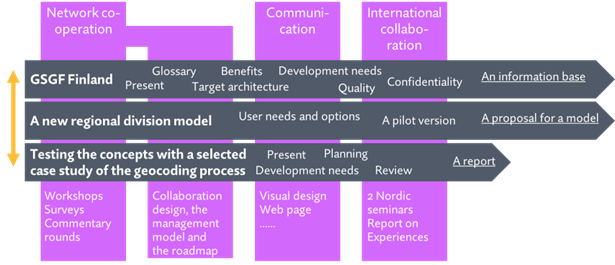
Structure of the work being undertaken during the GSFI project
There is a lot of value in adapting the GSGF to the Finnish context, as Mervi Haakana from Statistics Finland describes:
The focus of this project and the value of its results is to understand the theoretical models in practice and connected to the national policy and operating environment. Already at this stage of the work, examining different perspectives of the GSGF and GSGF Europe in our own environment has proven to be important. Even translating part of the text (not all) into Finnish has led to discussions and new understanding about the framework. One aim is also to bring the ability to share responsibilities and concrete tasks between organisations and to identify mutual processes. We also hope that the project results will serve as a valuable benchmark for other countries.
It is clear that the GSFI project is already achieving some great results and we look forward to hearing more as the project progresses! We also hope that the GSFI project will inspire you to embark on your own journeys towards successfully implementing the GSGF.
Adopting the GSGF will bring many benefits . . .
 . . . so why wait to get started?
Next time . . .
We will take a look at the UN Integrated Geospatial Information Framework, another key policy framework relating to data integration. Hopefully see you then!

This document was produced with the financial assistance of the European Union. The views expressed herein can in no way be taken to reflect the official opinion of the European Union.