Hello again and welcome back to INGEST. Last time, we shared the first post of a four-part mini-series on the UNECE Survey where we introduced you to an EU-funded project being led by UNECE to develop capacity in geospatial and statistical data integration, and provided some background and context to the survey. If you missed this post, you can find it here: UNECE Survey - Part 1: Background and Context
In the second part of this mini-series, we will dive in to the results from the UNECE Survey where we will focus on questions relating to the organisational use of geospatial and statistical data and technology. Let's get started!
Firstly, why look at the use of data and technology?
Well, on a global scale, society is becoming ever more data-driven with more than 2.5 quintillion bites of data being generated every day (which is quite something)! The availability of quality data that is accurate, comprehensive, at an appropriate level of detail and temporality, and from verifiable and authoritative sources, is critical for evidence-based decision-making and policy development across all levels. Data plays a central role in the 2030 Agenda and the ability to fully measure and monitor progress on the SDGs. Not only is the quality of data important, but also the strength of the technical infrastructure which underlies its creation, management, use, and dissemination within and across organisations. A strong data infrastructure will ensure better efficiency and productivity of its users, ease of collaboration between different groups, and securely managed access to organisational data for both internal and external users. By utilising appropriate digital technologies and methodological frameworks to collect, analyse and interpret data, real actionable insights can be obtained. Yet, these benefits have not yet been fully realised in a consistent way as the World Bank notes: “Even as new technology makes more data and wider uses of data possible, there are still many blank spaces on the global data map”. While both the quality and availability of data has been growing over recent years, in general, it is considered that “statistical capacity still needs strengthening and data literacy must be enhanced at all levels of decision-making” which will “require coordinated efforts on the part of data producers and users from multiple data systems" (UN Statistics Division).

The quality and accessibility of statistical and geospatial data, and the strength of the technical infrastructure that supports it throughout its lifecycle, is central to the data integration agenda. At a global level, it has been recognised that advances in the integration of statistical and geospatial data have "benefitted from the availability of powerful geospatial tools that enhance the value and usability of official statistics by leveraging the application of the spatial context" (PARIS21). The GEOSTAT 4 / GISCO survey also revealed that around 50% of the countries surveyed reported that they had a strong and sustainable data infrastructure that could support the integration of statistical and geospatial information. The INSPIRE Directive also brought the importance of metadata, and its uniform structure, to the fore in the management of spatial datasets, providing definitions and lists of categories to describe the content, data type, and usage. As UNECE have highlighted, there is also the “prior existence of flexible frameworks for the modernisation of official statistics that can be adapted to include geospatial information with little impact on the existing organisational structure”. For example, UNECE’s Generic Statistical Business Process Model (GSBPM) has recently been enhanced to include a geospatial perspective, appropriately termed GeoGSBPM. We will be discussing the GeoGSBPM in more detail in a later post. From these few examples, it is clear that good progress has been made at global and regional scales to highlight and support the development and maintenance of high-quality data and robust technical infrastructures, but issues still remain which hinder the greater integration of statistical and geospatial information at national levels.
So, what did the UNECE Survey discover?
Recognising the central role that data and technology play in the integration of geospatial and statistical information, the UNECE Survey asked respondents a number of questions relating to their organisational use of data and technology. Some highlights are presented below:
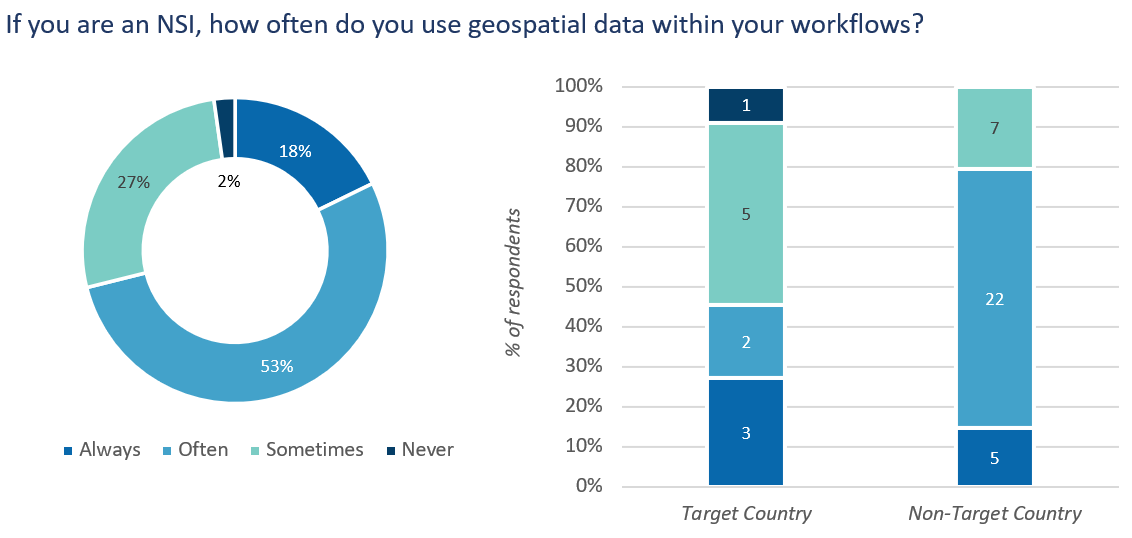
- Most respondents from National Statistical Institutes (NSIs) often (53%) or always (18%) used geospatial data within their workflows.
- Only one NSI respondent never used geospatial data in their workflows.
- A lower proportion of NSI respondents from the project's target countries (located in Eastern Europe, the Caucasus and Central Asia) always or often used geospatial data within their workflows (45%) in comparison to non-target countries (79%).
- Respondents noted a broad range of uses for geospatial data within statistical processes, with the most common relating to census operations, geocoding, spatial analysis, and dissemination activities. Several respondents also discussed their production of grid statistics, particularly in relation to population and age information.
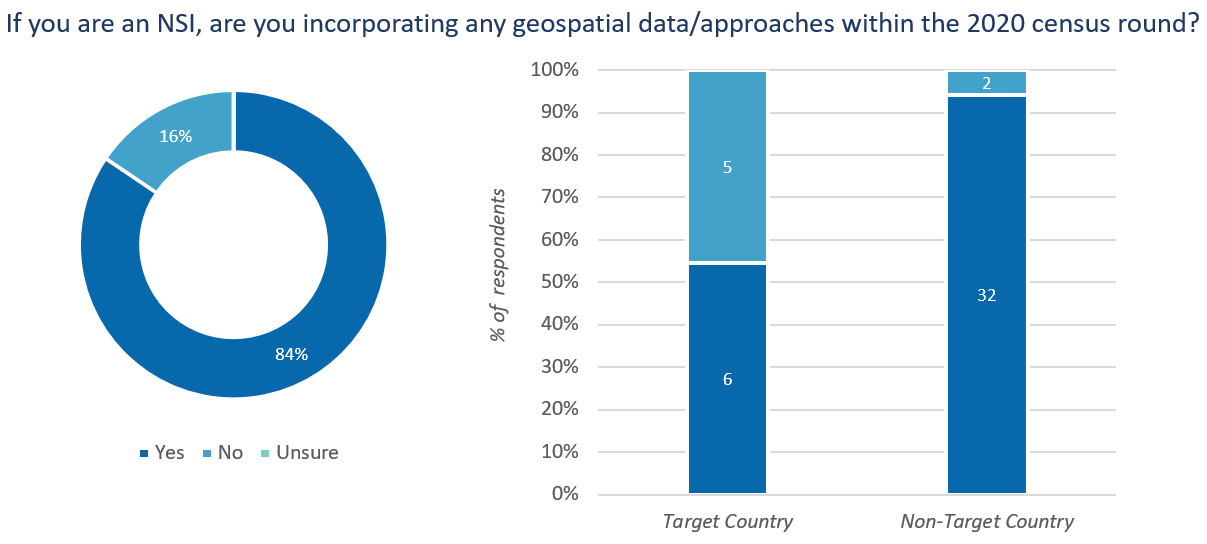
- An overwhelming majority (84%) of NSI respondents have, or are planning to incorporate, geospatial data within the 2020 census round.
- The proportion of NSIs using geospatial data within their census activities was much lower in target countries (55%) than non-target countries (94%).
- The most common uses of geospatial data within census operations related to the geocoding of address data for building and dwelling registers, the production of enumeration areas, the monitoring of data collection and census progress, and the creation and dissemination of grid statistics (primarily at the 1 kilometre-squared grid level but as high as 100 metres-squared).
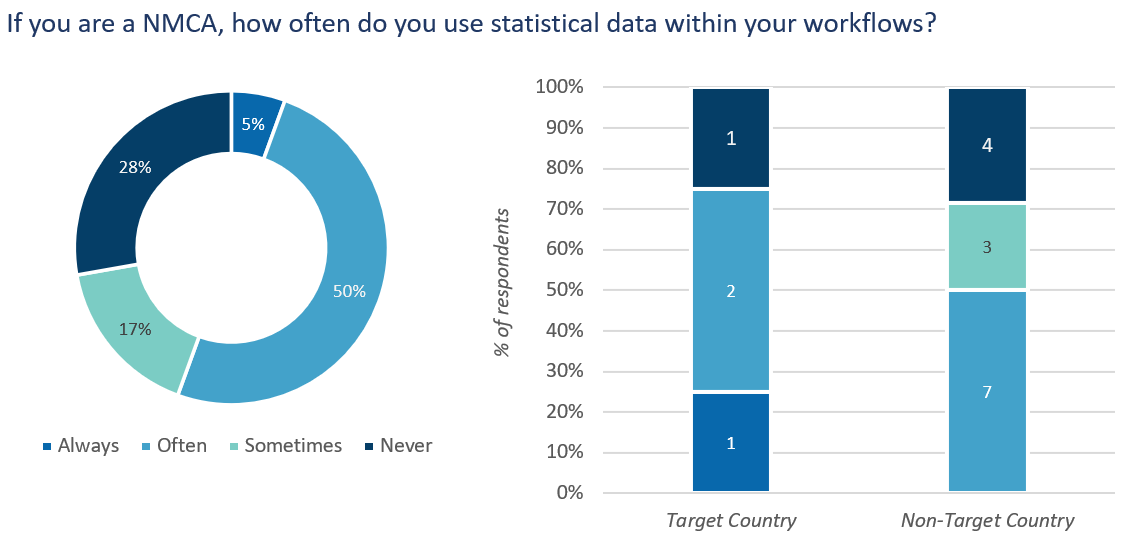
- A slight majority of respondents from National Mapping and Cadastral Agencies (NMCAs) often (50%) or always (5%) used statistical data in their workflows which is much lower than the converse reported by NSIs (as above).
- 28% of NMCA respondents never used statistical data in their workflows which is much higher than the converse reported by NSIs.
- A higher proportion of NMCA respondents from target countries always or often used statistical data (75%) than from non-target countries (50%).
- Common uses of statistical data within geospatial activities included within data production and management processes, thematic map production (particularly using population and census data), and spatial analysis using demographics and deprivation indices to inform policy development and emergency preparedness and response.
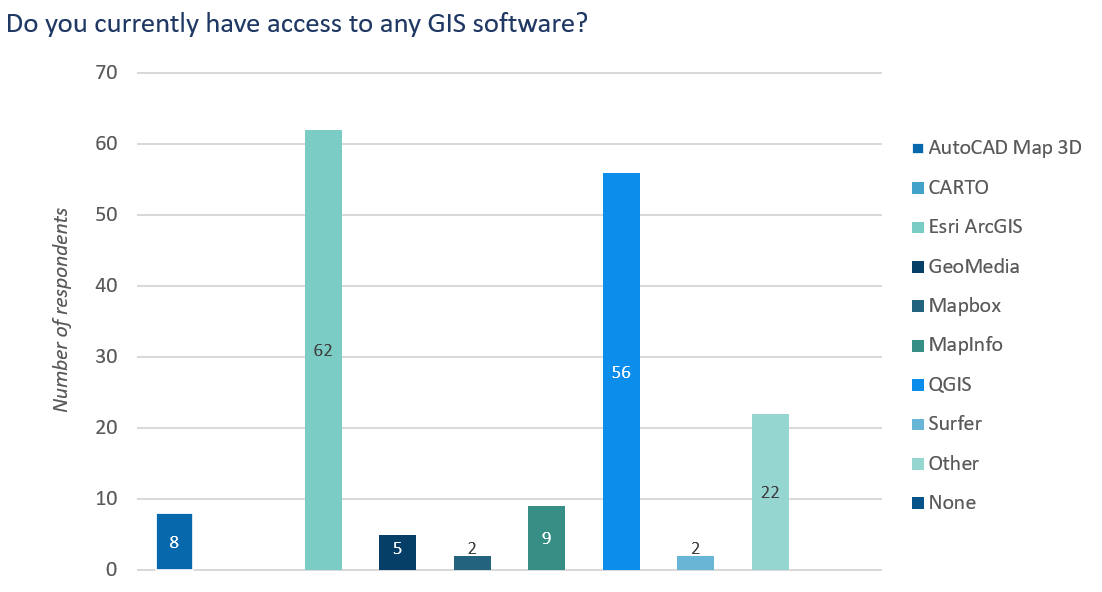
- All respondents, whether NSI or NMCA, had access to some form of GIS software, with the most popular being Esri ArcGIS software (37%) followed closely by open-source QGIS software (34%), and then other more bespoke or internally-developed software applications and packages (22%).

- The vast majority of respondents (with the exception of three organisations) had access to one or more statistical software packages, the most common being Microsoft Excel (28%), R (20%) and Python Statistics Libraries (15%).
These highlights from the survey suggest that organisations who responded to the survey are integrating geospatial/statistical data within their workflows and have a good level of access to relevant software to support such tasks. It is clear, however, that there are some disparities in the extent of data integration activities between NSIs and NMCAs and, similarly, between target and non-target countries. In a later post, we will share some of the issues and obstacles relating to data and technology which were highlighted by respondents to the survey.
Next time . . .
We will continue with the third part of our mini-series and share more results from the UNECE Survey which will focus on collaboration and partnerships, exploring the level of involvement in wider activities relating to geospatial and statistical data integration at national and international levels. We hope to see you then!


This document was produced with the financial assistance of the European Union. The views expressed herein can in no way be taken to reflect the official opinion of the European Union.
