Welcome to another instalment of INGEST! We hope that you have enjoyed reading our earlier posts where we introduced you to the concept of integrating geospatial and statistical data, highlighted why it is important, presented some of the key players in the field, and brought you up to speed on recent developments and activities.
We would now like to introduce you to an EU-funded project being led by UNECE to develop capacity in geospatial and statistical data integration across the UNECE region and present some results from the recent UNECE Survey on the Integration of Statistical and Geospatial Information which was undertaken as part of this project.
As there is a lot of talk about, we have developed a four-part mini-series where we will provide an overview of the project and present some results from the survey as follows:
- Part 1: Background and context
- Part 2: Data and technology
- Part 3: Collaboration and partnerships
- Part 4: Issues and obstacles
In the first post of this mini-series, we will introduce you to the project and provide some background and context to the UNECE Survey. Are you ready to find out more? Let's go!!
So, tell me more about your EU-funded project to develop capacity in geospatial and statistical data integration . . .
As we outlined in our first post (Welcome to INGEST), the role of integrated data as a driver for evidence-based decision-making has never been more important and has been brought to the fore by the 2030 Agenda and its call for data that is accurate, current and of high-resolution to measure and monitor the achievement of its Sustainable Development Goals. In our previous post (Key players and recent developments) we also discussed how global efforts to drive the greater integration of statistical and geospatial data have been going on for a decade and many great outcomes have been achieved, however, the benefits have not yet been fully realised consistently across the UNECE region due a to range of complex but interconnected reasons (which we will discuss in a later post).
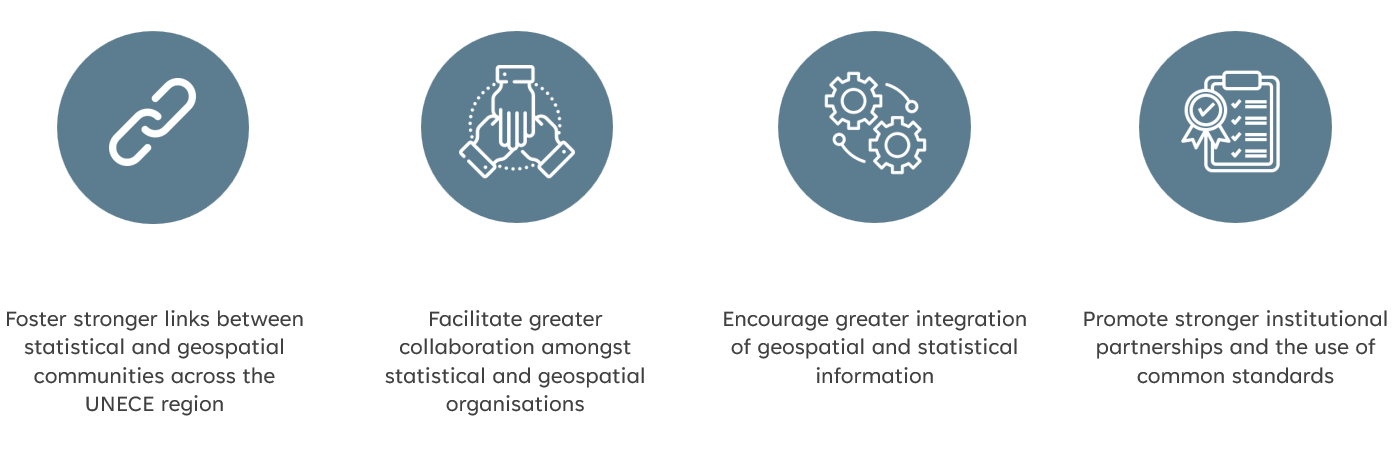
Recognising the potential for growth, the European Commission has funded a 21-month project, currently being led by UNECE, to develop greater capacity in statistical and geospatial data integration across the UNECE region to foster stronger links between the two communities, support greater collaboration and encourage greater data integration through the promotion of stronger institutional partnerships and the adoption of common standards. The project is supporting existing activities to strengthen the integration of statistical and geospatial information by Eurostat, UN-GGIM: Europe and others, and has a particular focus on sixteen selected target countries in Eastern Europe, the Caucasus and Central Asia.
A number of key activities are being undertaken as part of the project including (amongst other things):
- Issuing an online survey to gain stakeholder insights on data integration (more on that below).
- Organising a Joint UNECE / Eurostat / UN-GGIM: Europe Workshop on Integrating Statistical and Geospatial Data which will take place in Belgrade, Serbia on the 4-5 October 2023.
- Establishing a UNECE-led task force on standards issues relating to data integration.
- Creating supportive material on data integration including a UNECE wiki space, this blog series, and other documentation.
By carrying out these activities, the project hopes to:
- Increase awareness of the need for more integration of geospatial and statistical data, especially within the project's target countries.
- Develop a better understanding of the limitations of current geospatial and statistical data standards in the context of data integration.
- Improve collaboration between the geospatial and statistical communities based on greater mutual awareness and understanding.
What is the UNECE Survey on Integration of Statistical and Geospatial Information all about?
Well, the UNECE Survey on the Integration of Statistical and Geospatial Information was developed as part of the wider project to:
- Obtain valuable insight on data integration from statistical and geospatial communities across the UNECE region.
- Ensure that the views of key stakeholders were included within the project.
- Acquire user-centric feedback to accurately inform and target the direction of future project activities.
The UNECE Survey was issued to all National Statistical Institutes (NSIs) and National Mapping and Cadastral Agencies (NMCAs) located across the UNECE region in the spring of 2023. The survey was designed around four key areas:
- The use of data and technology to support data integration.
- The level of involvement in wider activities relating to geospatial and statistical data integration at national and international levels.
- Develop an understanding of the issues and obstacles limiting the greater integration of geospatial and statistical data, structured using the strategic pathways of the UN Integrated Geospatial Information Framework (UN-IGIF).
- Provide an opportunity for NSIs and NMCAs to register their interest in future project activities.
Could you tell me more about who responded to the UNECE Survey?
Absolutely, we are pleased to share that the UNECE Survey received a great response as the below map shows:

Key facts and figures:
- 67 organisations from 49 countries responded to the survey.
- Survey respondents came from across the UNECE region and beyond, including Brazil, Chile, China, Colombia, India, Japan, and Mexico.
- 15 respondents came from a project target country located in Eastern Europe, the Caucasus or Central Asia.
- 45 (67%) respondents were from NSIs, 18 (27%) were from NMCAs, and 4 (6%) were from other institutions (where the national statistical and geospatial functions were combined or had an academic or research function).
- In 17 countries, responses were received from both the NSI and NMCA, ensuring that valuable dual perspectives from statistical and geospatial communities were obtained at national levels. Four of these countries were a target country of the project.
Next time . . .
We will present more results from the UNECE Survey in the second part of our mini-series which will focus on the organisational use of geospatial and statistical data and technology. See you then!


This document was produced with the financial assistance of the European Union. The views expressed herein can in no way be taken to reflect the official opinion of the European Union.
