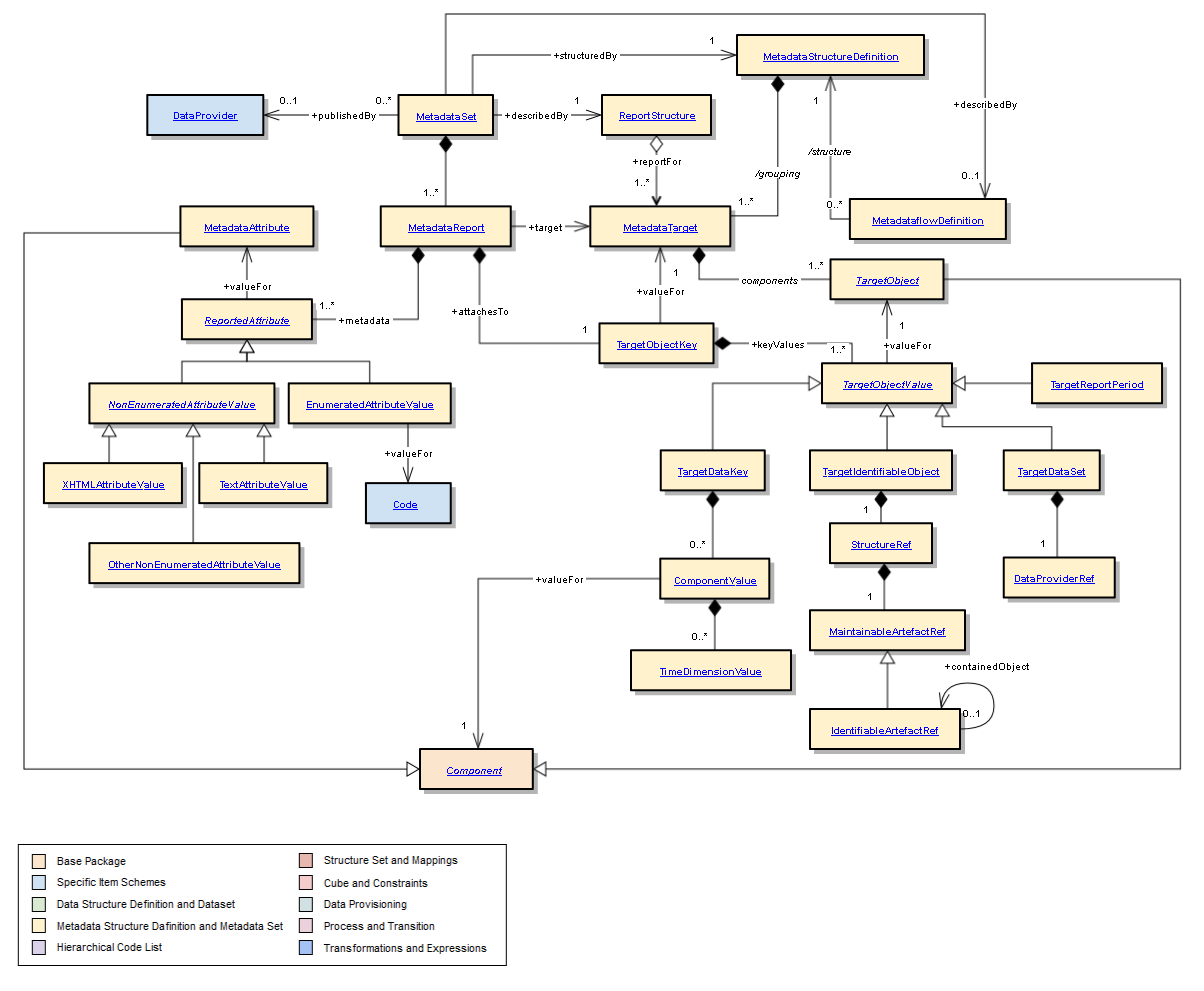
Explanation of the diagram
The MetadataSet must conform to the MetadataStructureDefinition associated to the MetadataflowDefinition for which this MetadataSet is an “instance of metadata”.
The model shows the association to the classes of the MetadataStructureDefinition, this is for conceptual purposes to show the link to the MetadataStructureDefinition. In the actual MetadataSet as exchanged there must, of course, be a reference to the MetadataStructureDefinition and the ReportStructure, and optionally a MetadataflowDefinition, but the MetadataStructureDefinition is not necessarily exchanged with the metadata. Therefore, the MetadataStructureDefinition classes are shown as these are not a part of the MetadataSet itself.
An organisation playing the role of DataProvider can be responsible for one or more MetadataSet. A MetadataSet comprises one or more MetadataReport, each of which must be for the same ReportStructure. It references both a MetadataTarget, defined in the MetadataStructureDefinition, and contains a TargetObjectKey and ReportedAttributes.
The identified ReportStructure specifies which MetadataAttributes are expected as ReportedAttributes. The identified MetadataTarget specifies the expected content of the TargetObjectKey i.e. it specifies the information required to identify the object for which the ReportedAttributes are reported.
- The TargetObjectValue can be one of:
- TargetDataKey – this can contain:
- o a SeriesKey (set of dimension values)
- o a SeriesKey plus a value or values (giving time range) for the TimeDimension (TimeDimensionValue),
- o a value of values for the TimeDimension
- TargetIdentifiableObject -this identifies any identifiable object (which includes both Maintainable and Identifiable objects
- TargetDataSet – this identifies a DataSet
- TargetReportPeriod – this specifies the report period for the Report
A simple text value for the ReportedAttribute uses the NonEnumeratedAttributeValue sub class of ReportedAttribute whilst a coded value uses the EnumeratedAttributeValue sub class.
The NonEnumeratedAttributeValue can be one of:
- XHTMLAttributeValue – the content is XHTML
- TextAttributeValue – the content is textual and may contain the text in multiple languages
- OtherNonEnumeratedAttributeValue – the content is a string value that must conform to the Representation specified for the MetadataAttribute in the MetadataStructureDefinition for the relevant ReportStructure
The EnumeratedAttributeValue contains a value for a Code specified as the Representation for the MetadataAttribute in the MetadataStructureDefinition for the relevant ReportStructure.